
What Is a 1031 Exchange for Charlotte Luxury Real Estate?
Last updated: March 13, 2026
SHORT ANSWER
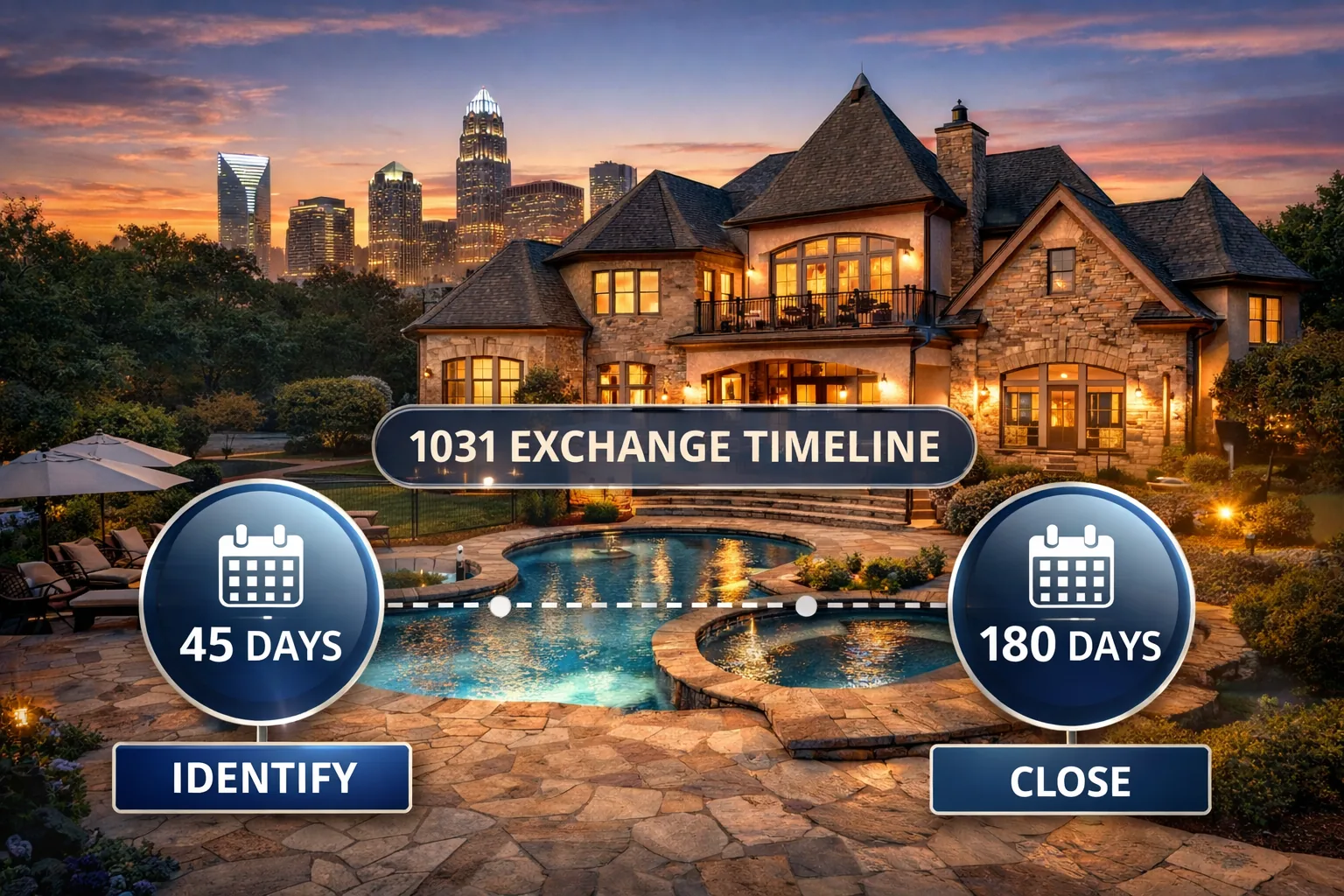
A 1031 exchange allows Charlotte luxury real estate investors to defer up to 32.8% in combined federal and North Carolina capital gains taxes by reinvesting proceeds from the sale of an investment property into a like-kind replacement property. Investors must identify replacement property within 45 days and close within 180 days. For a $2M Charlotte luxury investment property with $800,000 in gains, this can defer approximately $262,000 in taxes, preserving capital for portfolio growth.
EXECUTIVE SUMMARY
- Tax Deferral Power: Charlotte luxury investors can defer 20% federal capital gains, 3.8% NIIT, 25% depreciation recapture, and 3.99% NC state tax through a properly executed 1031 exchange.
- Strict IRS Deadlines: The 45-day identification period and 180-day exchange period are absolute. No extensions are granted for any reason, including weekends, holidays, or natural disasters.
- Charlotte Market Advantage: With luxury home prices up 121% over the past decade, Charlotte investors are sitting on significant unrealized gains that make 1031 exchanges increasingly valuable.
- Four Exchange Types: Delayed (most common), simultaneous, reverse (buy first), and improvement (build-to-suit) exchanges each serve different Charlotte luxury investment strategies.
- DST Exit Strategy: Delaware Statutory Trusts allow luxury property owners to exchange into passive, institutional-grade real estate with minimum investments of $100,000 to $250,000.
- 2026 Legislative Status: 1031 exchanges remain fully intact under the OBBBA (One Big Beautiful Bill Act). No changes to the rules since the TCJA in 2017.
Wealth Arbitrage Calculator
See what moving to North Carolina is worth to you
UNDERSTANDING THE 1031 EXCHANGE FOR CHARLOTTE LUXURY REAL ESTATE
The 1031 exchange is the single most powerful tax deferral tool available to Charlotte luxury real estate investors, and understanding how it works is the difference between preserving hundreds of thousands of dollars in equity and writing a massive check to the IRS. With Charlotte luxury home prices up 121% over the past decade and significant unrealized gains embedded in properties across Charlotte's premier neighborhoods, the strategic importance of 1031 exchanges has never been greater. Whether you are repositioning a $1.5M rental in Myers Park into a multifamily asset or exchanging a $4M Lake Norman investment property into a Delaware Statutory Trust, the mechanics, timelines, and pitfalls of the 1031 exchange demand precision. To see a personalized breakdown of your financial advantage, use the Charlotte Wealth Arbitrage Calculator above.
1031 EXCHANGE TAX DEFERRAL BY PRICE BAND: CHARLOTTE LUXURY PROPERTIES
The tax savings from a 1031 exchange scale dramatically with property value, and Charlotte's luxury price bands illustrate exactly how much capital is at stake. The table below breaks down the estimated tax deferral for each price band, assuming a 40% capital gain relative to sale price and the maximum combined federal and NC tax rate of 32.8%.
| Price Band | Estimated Capital Gain | Federal Capital Gains (20%) | NIIT (3.8%) | NC State Tax (3.99%) | Total Tax Deferred |
|---|---|---|---|---|---|
| $1M to $1.5M | $400K to $600K | $80K to $120K | $15.2K to $22.8K | $16K to $23.9K | $111K to $167K |
| $1.5M to $2M | $600K to $800K | $120K to $160K | $22.8K to $30.4K | $23.9K to $31.9K | $167K to $222K |
| $2M to $3M | $800K to $1.2M | $160K to $240K | $30.4K to $45.6K | $31.9K to $47.9K | $222K to $333K |
| $3M to $5M | $1.2M to $2M | $240K to $400K | $45.6K to $76K | $47.9K to $79.8K | $333K to $556K |
| $5M+ | $2M+ | $400K+ | $76K+ | $79.8K+ | $556K+ |
The data tells a clear story. A Charlotte investor selling a $2M luxury rental property in Myers Park with $800,000 in capital gains faces approximately $222,000 in combined taxes. A 1031 exchange defers that entire amount, allowing the full proceeds to be reinvested into a replacement property. Over multiple exchanges across a career, this compounding deferral can preserve millions of dollars in equity that would otherwise be lost to taxation.
THE 45-DAY AND 180-DAY DEADLINES: WHY TIMING IS EVERYTHING
The two most critical numbers in any 1031 exchange are 45 and 180, and missing either deadline by even a single day will disqualify the entire exchange. The moment you close on the sale of your relinquished property, two clocks start running simultaneously. You have exactly 45 calendar days to submit a written identification of your replacement property to your qualified intermediary. You then have 180 calendar days from that same closing date to complete the purchase of the replacement property.
These deadlines are absolute. The IRS does not grant extensions for any reason. If day 45 falls on a Saturday, your identification is due on that Saturday. If a hurricane delays your closing past day 180, the exchange fails. For Charlotte luxury investors, this means your replacement property search must begin well before you list your relinquished property. Working with a luxury real estate specialist like Mitch Boraski who understands both the Charlotte market and 1031 exchange mechanics is essential to meeting these deadlines without compromising on property quality.
THE THREE IDENTIFICATION RULES: CHOOSING YOUR REPLACEMENT PROPERTY
The IRS provides three methods for identifying replacement properties, and choosing the right rule depends on your investment strategy and the Charlotte luxury inventory available during your 45-day window. The Three Property Rule allows you to identify up to three replacement properties of any value. This is the most commonly used rule and works well when you have already identified specific Charlotte luxury properties that meet your investment criteria. The 200% Rule allows you to identify any number of properties, but their combined fair market value cannot exceed 200% of the relinquished property's sale price. For a $2M sale, you could identify properties totaling up to $4M. The 95% Rule allows unlimited identifications but requires you to acquire at least 95% of the total identified value, making it the riskiest option.
For Charlotte luxury investors, the Three Property Rule is typically the safest approach. Identifying three properties in the $1M to $3M range across neighborhoods like SouthPark, Ballantyne, or Eastover provides flexibility while keeping the exchange manageable. If you are considering a Delaware Statutory Trust as one of your identified properties, it counts as one of your three identifications under the Three Property Rule.
UNDERSTANDING BOOT: THE HIDDEN TAX TRIGGER IN LUXURY EXCHANGES
"Boot" is the term for any value received in a 1031 exchange that is not like-kind real property, and it triggers immediate tax liability on the amount received. Boot comes in two primary forms. Cash boot occurs when you receive cash from the exchange, either intentionally or because the replacement property costs less than the relinquished property. Mortgage boot occurs when the debt on your replacement property is less than the debt on your relinquished property, meaning you have effectively received debt relief.
For Charlotte luxury investors, mortgage boot is the most common pitfall. If you sell a $3M investment property with a $1.5M mortgage and purchase a $3M replacement property with only a $1M mortgage, you have received $500,000 in mortgage boot, which is taxable. The solution is straightforward: ensure your replacement property's value and debt equal or exceed your relinquished property. If you are purchasing a luxury property in Charlotte as your replacement, work with your CPA to model the exact numbers before making an offer.
FOUR TYPES OF 1031 EXCHANGES FOR CHARLOTTE LUXURY INVESTORS
Not all 1031 exchanges follow the same structure, and Charlotte luxury investors have four distinct exchange types to match their specific investment timeline and strategy. The Delayed Exchange is the most common type, accounting for the vast majority of all 1031 transactions. You sell your relinquished property first, then identify and acquire replacement property within the 45/180-day deadlines. This is the standard approach for Charlotte investors who are repositioning from one luxury investment property to another.
The Reverse Exchange flips the sequence: you acquire the replacement property first, then sell the relinquished property within 180 days. This is ideal when a compelling Charlotte luxury investment opportunity appears before you have sold your current property. Reverse exchanges are significantly more complex and expensive, with qualified intermediary fees ranging from $5,000 to $15,000 or more, but they eliminate the risk of losing a prime replacement property during the identification period.
The Improvement Exchange (also called a Build-to-Suit Exchange) allows you to use exchange funds to improve or construct on the replacement property. This is particularly relevant for Charlotte investors who want to acquire a luxury property and renovate it to a higher standard before the 180-day deadline. The Simultaneous Exchange, where both properties close on the same day, is the simplest but rarest type, as coordinating same-day closings on luxury properties is logistically challenging.
Get Your Confidential Home Valuation
Whether you are considering a 1031 exchange or simply exploring your options, the first step is knowing your Charlotte luxury property's true market value. Get a confidential, data-driven valuation of your investment property.
DELAWARE STATUTORY TRUSTS: THE PASSIVE 1031 EXIT STRATEGY
A Delaware Statutory Trust (DST) is a passive real estate investment vehicle that qualifies as like-kind replacement property in a 1031 exchange, making it the ideal exit strategy for Charlotte luxury property owners who want to defer taxes while eliminating active management responsibilities. DSTs own institutional-grade properties such as Class A multifamily communities, medical office buildings, industrial warehouses, and net-leased retail properties. These assets typically range from $30M to $100M in total value, with individual investor participation starting at $100,000 to $250,000.
For Charlotte luxury investors, DSTs solve a common problem: you want to defer capital gains on a $3M Eastover investment property, but you do not want to take on another active management role. By exchanging into a DST, you receive passive monthly income distributions, professional institutional management, and full 1031 tax deferral. The trade-off is that DSTs are illiquid investments with hold periods typically ranging from 5 to 10 years, and you have no control over property management decisions. Charlotte-based 1031 exchange advisors can help identify DST offerings that align with your income needs and risk tolerance.
THE QUALIFIED INTERMEDIARY: YOUR MOST IMPORTANT PARTNER
A qualified intermediary (QI) is the required third party who holds your exchange funds between the sale of the relinquished property and the purchase of the replacement property, and selecting the right QI is arguably the most critical decision in the entire 1031 process. The IRS requires that exchange funds never touch your hands or your bank account at any point during the exchange. The QI receives the proceeds at closing, holds them in a segregated escrow account, and releases them directly to the closing agent when you purchase the replacement property.
Your QI cannot be someone who has served as your attorney, accountant, real estate agent, or employee within the past two years. This "related party" restriction exists to prevent conflicts of interest. Standard QI fees for a delayed exchange range from $600 to $1,500, while reverse exchanges can cost $5,000 to $15,000 or more due to their complexity. For Charlotte luxury exchanges involving $2M or more in proceeds, prioritize QIs with FDIC-insured escrow accounts and fidelity bond coverage. The risk of a QI going bankrupt with your exchange funds, while rare, has occurred in the past and can be catastrophic.
CHARLOTTE MARKET CONTEXT: WHY 1031 EXCHANGES MATTER NOW MORE THAN EVER
Charlotte's 121% luxury home price appreciation over the past decade means that long-term investment property owners are sitting on historically large unrealized capital gains, making 1031 exchanges more valuable today than at any point in the city's history. An investor who purchased a $1M rental property in Myers Park in 2016 is now looking at a property worth approximately $2.2M, with over $1M in embedded capital gains. Without a 1031 exchange, selling that property would trigger approximately $278,000 in combined federal and NC taxes. With a 1031 exchange, that entire amount is deferred and reinvested.
Charlotte's position as the second largest banking center in the United States continues to drive executive relocation and luxury rental demand. Investors who are selling luxury investment properties in established neighborhoods can exchange into emerging luxury corridors where appreciation potential remains strong. The key is working with a team that understands both the Charlotte luxury market dynamics and the technical requirements of a 1031 exchange. If you are considering a 1031 exchange on a Charlotte luxury property, schedule a confidential strategy call to discuss your specific situation.
HOW TO EXECUTE A 1031 EXCHANGE ON A CHARLOTTE LUXURY PROPERTY: A 5-STEP GUIDE
1
Assemble Your 1031 Exchange Team Before Listing
Engage a qualified intermediary, 1031 exchange attorney, CPA, and luxury real estate agent before listing your property. The QI must be selected and contracted before closing on the relinquished property. Your CPA should model the full tax impact, including federal capital gains (20%), NIIT (3.8%), depreciation recapture (25%), and NC state tax (3.99%), to determine whether a standard, reverse, or improvement exchange is optimal for your situation. Begin identifying potential replacement properties in Charlotte's luxury neighborhoods during this phase.
2
Close on the Relinquished Property and Start the Clock
Close on the sale of your current investment property. The QI receives and holds all net proceeds in a segregated, FDIC-insured escrow account. The 45-day identification period and 180-day exchange period begin simultaneously on the closing date. You cannot touch the exchange funds at any point during this process. Any constructive receipt of funds, even briefly, will disqualify the entire exchange. Coordinate with your listing agent to ensure the closing documents properly reference the 1031 exchange and QI assignment.
3
Identify Replacement Property Within 45 Days
Submit a written identification of replacement properties to your QI within 45 calendar days. Use the Three Property Rule to identify up to 3 properties of any value, or the 200% Rule to identify more properties whose total value does not exceed 200% of the relinquished property. This deadline is absolute with no extensions. For Charlotte luxury investors, consider identifying a mix of direct investment properties and a Delaware Statutory Trust as a backup option to ensure you can close within the 180-day window.
4
Conduct Due Diligence and Negotiate the Replacement Property
Perform inspections, appraisals, and financial analysis on your identified replacement properties. For Charlotte luxury investment properties, evaluate rental income potential, HOA restrictions on short-term and long-term rentals, neighborhood appreciation trends, and insurance costs. Negotiate terms and secure financing if needed, keeping the 180-day deadline in focus. Ensure the replacement property value and debt equal or exceed the relinquished property to avoid taxable boot. If purchasing in Charlotte, work with an agent who understands both the luxury market and 1031 exchange requirements.
5
Close on the Replacement Property Within 180 Days
Complete the acquisition of the replacement property using exchange funds held by the QI. The QI transfers funds directly to the closing agent. Ensure all closing documents reference the 1031 exchange. File IRS Form 8824 with your tax return for the year of the exchange, reporting the relinquished property, replacement property, and any boot received. Maintain detailed records of all exchange documents, QI correspondence, and property identification letters for a minimum of seven years in case of IRS audit.
KEY MARKET TAKEAWAY
Charlotte luxury investors who execute 1031 exchanges strategically can defer hundreds of thousands of dollars in capital gains taxes while repositioning into higher-performing assets. With luxury prices up 121% over the past decade and the OBBBA preserving 1031 exchange rules intact, the window for tax-deferred portfolio growth remains wide open. The critical success factors are assembling your team before listing, respecting the 45/180-day deadlines with zero margin for error, and ensuring replacement property value and equity match or exceed the relinquished property. Whether you exchange into another Charlotte luxury investment, a Lake Norman property, or a passive DST, the 1031 exchange is the most powerful wealth preservation tool in your real estate arsenal.
WHAT'S NEXT: YOUR 1031 EXCHANGE ACTION PLAN
If you are holding a Charlotte luxury investment property with significant embedded gains, the time to plan your 1031 exchange strategy is now, not when you are ready to sell. The 45-day identification deadline demands that you have replacement properties researched and vetted before your relinquished property even goes under contract. Schedule a confidential strategy call with Mitch Boraski to discuss your specific property, model the tax impact, and begin identifying replacement opportunities across Charlotte's luxury market. Every day you delay is a day closer to a taxable event that could cost you six figures.
FREQUENTLY ASKED QUESTIONS
What is a 1031 exchange for luxury real estate in Charlotte?
A 1031 exchange allows Charlotte luxury real estate investors to defer capital gains taxes by reinvesting proceeds from the sale of an investment property into a like-kind replacement property. Under IRS Section 1031, investors must identify replacement property within 45 days and close within 180 days. For Charlotte luxury properties, this can defer up to 32.8% in combined federal and NC state taxes on gains from $1M to $5M+ properties. Only properties held for investment or business use qualify; primary residences are excluded.
How much can I save with a 1031 exchange on a Charlotte luxury property?
Tax savings depend on your capital gain and income level. A Charlotte luxury investor selling a $2M investment property with $800,000 in capital gains could defer approximately $222,000 in combined taxes: 20% federal capital gains ($160,000), 3.8% NIIT ($30,400), and 3.99% NC state tax ($31,920), plus 25% depreciation recapture on accumulated depreciation. For a $5M+ property with $2M in gains, the deferral exceeds $556,000. These savings compound with each subsequent exchange, potentially deferring millions over an investment career.
Can I use a 1031 exchange on my primary residence in Charlotte?
No, a 1031 exchange only applies to property held for investment or business use. Your primary residence does not qualify. However, if you convert your Charlotte luxury home to a rental property and hold it as an investment for a minimum of two years, it may then qualify for a 1031 exchange. Some Charlotte homeowners use this strategy when relocating: they rent their former home for two or more years, then execute a 1031 exchange into a new investment property. Consult with a 1031 exchange attorney and CPA before attempting this conversion strategy.
What is a Delaware Statutory Trust and how does it work with a 1031 exchange?
A Delaware Statutory Trust (DST) is a passive real estate investment vehicle that qualifies as replacement property in a 1031 exchange. DSTs own institutional-grade properties like Class A multifamily, medical offices, or industrial buildings worth $30M to $100M. Individual investors can participate with as little as $100,000 to $250,000. DSTs are ideal for Charlotte luxury property owners who want to defer capital gains taxes while exiting active property management. The trade-off is illiquidity, with typical hold periods of 5 to 10 years, and no control over management decisions. DSTs count as one identification under the Three Property Rule.
Explore Related Resources
Luxury Home Seller's Guide
Our comprehensive guide to selling your luxury property in Charlotte, from pricing strategy to closing.
Luxury Home Buyer's Guide
A complete resource for buyers navigating the Charlotte luxury market, from neighborhood selection to negotiation.
Executive Relocation Guide
A strategic guide for executives relocating to Charlotte, covering wealth management, lifestyle, and real estate.
YOUR NEXT MOVE STARTS HERE
Whether you are planning a 1031 exchange, evaluating your luxury investment portfolio, or exploring your options in Charlotte's luxury market, get the strategic guidance you need from a specialist who understands both the market and the mechanics.
THE LUXURY INSIDER BRIEFING BOOK A STRATEGY CALL
REFERENCES
- Internal Revenue Service. "Like-Kind Exchanges Under IRC Section 1031." irs.gov
- KLR Tax Blog. "1031 Exchanges in 2026: What's Changed and What Investors Should Know." March 2026. kahnlitwin.com
- IPX1031. "Top Misconceptions About 1031 Exchanges." 2025. ipx1031.com
- Charlotte Observer. "Charlotte luxury home prices surge 121% over 10 years." January 2026. charlotteobserver.com
- EisnerAmper. "Delaware Statutory Trusts (DSTs) for 1031 Exchanges." December 2025. eisneramper.com
- DoorLoop. "IRS 1031 Exchange Rules for 2026: Everything You Need to Know." January 2026. doorloop.com
- First Exchange. "Federal Tax and Financial Rates 2026." January 2026. firstexchange.com