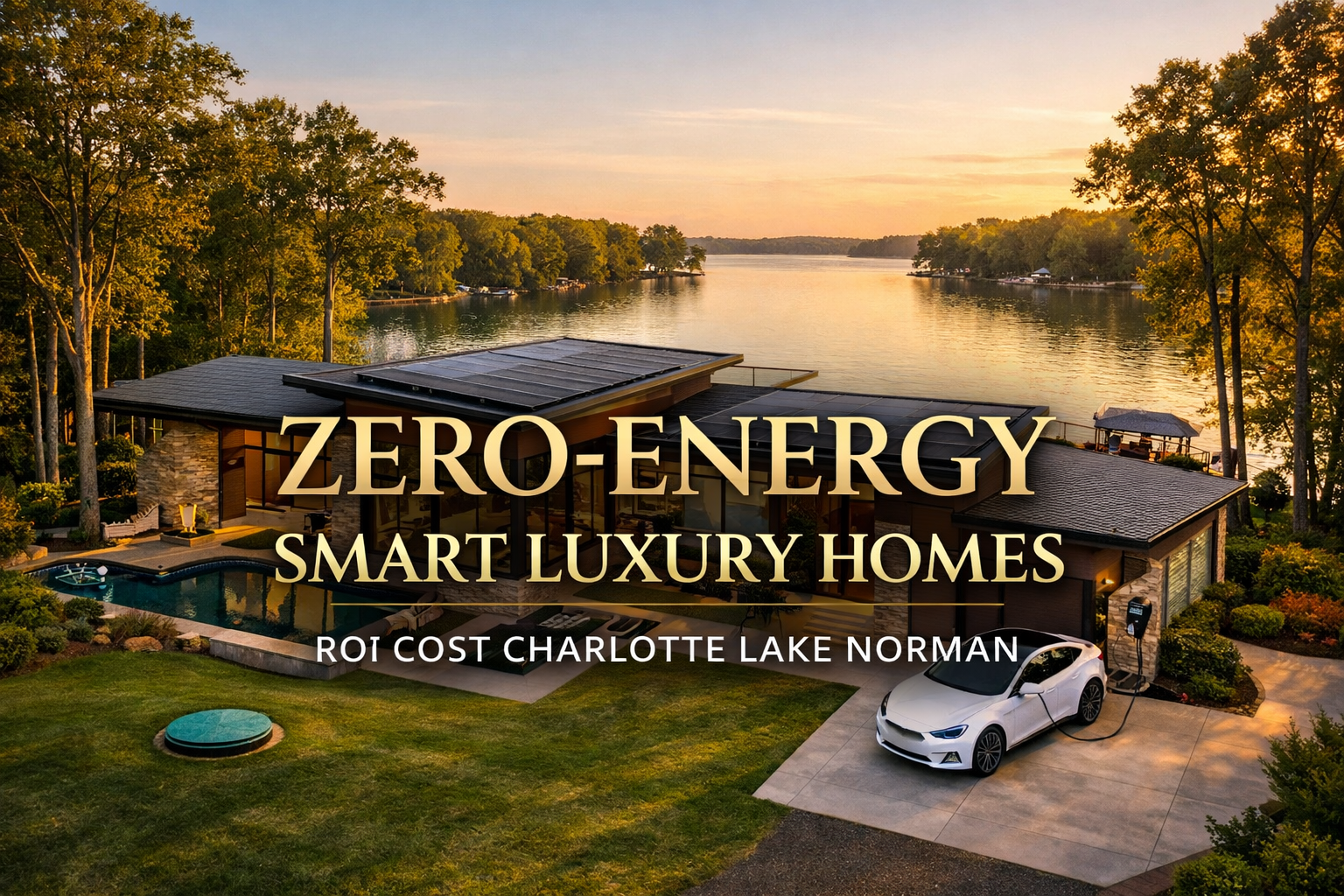
Zero-Energy Smart Luxury Homes ROI Cost Charlotte Lake Norman
By Mitch Boraski, MBA
Last updated: March 18, 2026
EXECUTIVE SUMMARY
- Zero-energy upgrades add 8 to 15 percent to luxury build costs, but the 30 percent federal tax credit and $8,000 to $13,000 in annual energy savings create a 5 to 10 year payback period.
- Smart home technology adds 3 to 5 percent to luxury resale values in Charlotte, with security systems delivering the highest ROI at 75 to 100 percent.
- Energy-efficient homes in the Charlotte metro command a 3 to 15 percent resale premium according to ENERGY STAR and IEA data.
- Lake Norman properties offer superior zero-energy potential due to larger lots, while Charlotte in-town neighborhoods offer walkability and urban smart home integration advantages.
- A combined zero-energy and smart home package for a $2M luxury home costs $140,000 to $400,000 before incentives, with a projected net value increase of $100,000 to $200,000 at resale.
SHORT ANSWER
Zero-energy and smart home upgrades for luxury properties in Charlotte and Lake Norman cost $140,000 to $400,000 before incentives. After the 30 percent federal tax credit, annual energy savings of $8,000 to $13,000, and a 3 to 15 percent resale premium, the net ROI is compelling. Smart home technology alone adds 3 to 5 percent to property values. For a $2 million luxury home, the combined value increase at resale ranges from $100,000 to $200,000.
WEALTH ARBITRAGE CALCULATOR
Discover Your Urban Advantage in Real-Time
ZERO-ENERGY UPGRADE COST BREAKDOWN: $2M LUXURY HOME
| Upgrade | Cost Range | After 30% ITC | Annual Savings | Payback (Years) |
|---|---|---|---|---|
| Solar Panels (15 kW System) | $35,000 to $45,000 | $24,500 to $31,500 | $2,400 to $3,600 | 7 to 10 |
| Geothermal HVAC | $35,000 to $60,000 | $24,500 to $42,000 | $3,000 to $5,000 | 6 to 9 |
| High Performance Insulation | $8,000 to $15,000 | N/A | $1,200 to $2,000 | 5 to 8 |
| Triple Pane Windows | $15,000 to $30,000 | N/A | $800 to $1,500 | 12 to 20 |
| Energy Recovery Ventilator | $3,000 to $6,000 | N/A | $400 to $800 | 5 to 8 |
| Total Zero-Energy Package | $96,000 to $156,000 | $57,000 to $88,500 | $7,800 to $12,900 | 5 to 12 |
THE REAL COST OF ZERO-ENERGY IN CHARLOTTE AND LAKE NORMAN
Building or retrofitting a luxury home to zero-energy standards in Charlotte costs 8 to 15 percent more than conventional construction, but the financial return is measurable and increasingly compelling. The term "zero-energy" refers to a home that produces as much energy as it consumes over the course of a year, typically through a combination of solar panels, geothermal heating and cooling, advanced insulation, and high-performance windows. In the Charlotte luxury market, this translates to a specific set of upgrades with well-documented costs and returns.
For a 5,000 square foot luxury home valued at $2 million, the total zero-energy upgrade package ranges from $96,000 to $156,000 before incentives. The single largest component is the solar panel system. A 15 kilowatt residential solar installation in North Carolina costs between $35,000 and $45,000 at current 2026 pricing of approximately $3.08 to $3.21 per watt, according to EnergySage and SolarReviews. After the 30 percent federal Investment Tax Credit, which remains available through 2032, the net cost drops to $24,500 to $31,500. Charlotte receives over 200 sunny days per year, making solar production reliable and predictable.
Geothermal HVAC represents the second major investment. Ground-source heat pump systems cost $35,000 to $60,000 for a luxury home, but they also qualify for the 30 percent federal tax credit, reducing the net cost to $24,500 to $42,000. The energy savings are substantial. Geothermal systems reduce heating and cooling costs by 40 to 60 percent compared to conventional HVAC, translating to $3,000 to $5,000 in annual savings for a Charlotte luxury home. The ground loop components last 50 years or more, while the heat pump unit typically lasts 25 years, making this one of the longest-lasting mechanical systems available.
The remaining components of a zero-energy package include high-performance spray foam or rigid insulation ($8,000 to $15,000), triple-pane windows ($15,000 to $30,000), and an energy recovery ventilator ($3,000 to $6,000). These elements do not qualify for the federal tax credit but deliver consistent energy savings and improve indoor air quality, a feature that luxury buyers increasingly prioritize.
THE RESALE PREMIUM: WHAT THE DATA SHOWS
Energy-efficient homes command a measurable resale premium that ranges from 3 to 15 percent depending on the level of certification and market conditions. ENERGY STAR data shows that rated, energy-efficient homes sell for 2 to 8 percent more than comparable conventional homes across most U.S. markets. The International Energy Agency's 2025 Asset Values report found even stronger premiums, ranging from 3 to 15 percent for residential properties and 13 to 20 percent for commercial buildings.
For a $2 million luxury home in Charlotte or on Lake Norman, a conservative 5 percent green premium translates to $100,000 in additional resale value. At the higher end of the range, a 10 percent premium would add $200,000. When combined with the cumulative energy savings over a 10-year holding period ($78,000 to $129,000), the total financial benefit of zero-energy construction ranges from $178,000 to $329,000, well above the net investment cost of $57,000 to $88,500 after incentives.
The Department of Energy's Zero Energy Ready Homes program has certified a growing number of properties in North Carolina. Green Built North Carolina, the state's leading green building certification program, reports increasing demand for net-zero certification, particularly in the luxury segment where buyers view energy independence as both a financial advantage and a lifestyle statement.
SMART HOME TECHNOLOGY: ROI BY FEATURE CATEGORY
Smart home technology adds 3 to 5 percent to the resale value of luxury homes, but the ROI varies significantly by feature category. According to Consumer Reports and industry data compiled by Rently, smart home technology has shifted from a luxury amenity to core infrastructure in 2026. The National Association of Realtors reported at CES 2026 that smart home technology has matured, with devices that are better designed, easier to use, and more aligned with how people actually live.
| Smart Feature | Cost Range | ROI at Resale | Buyer Priority (2026) |
|---|---|---|---|
| Smart Security + Cameras | $5,000 to $15,000 | 75% to 100% | Essential |
| Video Doorbells | $300 to $1,000 | 85% to 95% | Essential |
| Smart Thermostats (Zoned) | $2,000 to $5,000 | 80% to 90% | Expected |
| EV Charging (Level 2) | $1,500 to $3,000 | 75% to 90% | Expected |
| Automated Lighting | $10,000 to $30,000 | 60% to 75% | Expected |
| Whole Home Audio | $8,000 to $25,000 | 50% to 70% | Desirable |
| Motorized Shading | $10,000 to $25,000 | 40% to 60% | Desirable |
| Whole Home Automation (Crestron/Savant) | $50,000 to $150,000 | 30% to 50% | Premium |
The data reveals a clear pattern. The highest ROI smart features are those that address fundamental needs: security, energy management, and convenience. Smart security systems deliver 75 to 100 percent ROI because they address a universal concern. Smart thermostats return 80 to 90 percent because they provide both comfort and measurable energy savings. Video doorbells, despite their relatively low cost, deliver 85 to 95 percent ROI because they have become an expected feature across all price points.
At the luxury end of the spectrum, whole-home automation systems from brands like Crestron, Control4, and Savant cost $50,000 to $150,000 but deliver a lower percentage ROI of 30 to 50 percent. However, in the Charlotte luxury market where homes regularly sell above $2 million, these systems are increasingly expected rather than optional. Buyers relocating from technology hubs like San Francisco, New York, and Seattle expect seamless digital integration as a baseline feature of a luxury home, not an upgrade.
For Lake Norman waterfront properties, smart features take on additional importance. Automated dock lighting, remote-controlled irrigation systems, and smart pool management systems are becoming standard expectations for waterfront luxury buyers. These features add $15,000 to $40,000 to the smart home budget but contribute to the overall perception of a modern, well-maintained property.
CHARLOTTE VS. LAKE NORMAN: WHERE ZERO-ENERGY MAKES THE MOST SENSE
The choice between Charlotte and Lake Norman for zero-energy construction depends on lot size, solar exposure, and lifestyle priorities. Lake Norman properties offer distinct structural advantages for zero-energy homes. The average luxury lot on Lake Norman ranges from 1 to 3 acres, providing ample space for optimal south-facing solar panel arrays and horizontal ground-source geothermal loop fields. The open terrain and lower tree density on many lakefront lots maximize solar production potential.
Charlotte's premier in-town neighborhoods, including Myers Park, Eastover, and Foxcroft, present different considerations. The mature tree canopy that defines these neighborhoods creates significant shading that can reduce solar panel efficiency by 20 to 40 percent. Lot sizes in Myers Park average 0.3 to 0.8 acres, limiting the footprint available for ground-source geothermal loops. However, vertical bore geothermal systems, which drill 200 to 400 feet deep rather than spreading horizontally, work effectively on smaller lots at a cost premium of approximately 20 to 30 percent over horizontal systems.
Smart home technology, by contrast, performs equally well in both markets. Charlotte in-town neighborhoods benefit from stronger cellular and fiber internet infrastructure, which supports more reliable smart home connectivity. Lake Norman properties may require additional mesh networking equipment ($2,000 to $5,000) to ensure consistent coverage across larger lots and outbuildings.
Both markets show strong demand for green and smart features among luxury buyers. Working with Mitch Boraski and the L ISTRE Group provides access to builders and contractors who specialize in luxury green construction across both the Charlotte and Lake Norman markets.
THE CHARLOTTE GREEN LUXURY DEAL SHEET
Get a confidential, one page PDF analysis of the top 3 off market and best value energy-efficient luxury listings in Charlotte and Lake Norman this week. Properties selected for maximum appreciation and sustainability potential.
FEDERAL AND STATE INCENTIVES: THE 2026 LANDSCAPE
The federal incentive structure for zero-energy construction remains the most generous in U.S. history, and North Carolina offers additional state-level benefits that further reduce costs. The Inflation Reduction Act's 30 percent Investment Tax Credit applies to solar panels, battery storage systems, and geothermal heat pumps through 2032. For a luxury homeowner investing $80,000 in solar and geothermal systems, the federal credit alone saves $24,000.
Duke Energy, which serves the Charlotte and Lake Norman markets, offers net metering for residential solar installations. Excess energy produced during peak sun hours is credited against nighttime and cloudy-day consumption, effectively allowing the utility grid to function as a free battery. For a 15 kilowatt system on a Lake Norman property with optimal solar exposure, net metering can reduce annual electricity costs to near zero.
North Carolina's property tax exemption for solar energy systems is another significant benefit. The state exempts 80 percent of the appraised value of solar installations from property taxes. On a $40,000 solar system, this prevents approximately $640 per year in additional property taxes at Charlotte's current effective tax rate.
For buyers relocating from high-tax states, the combination of North Carolina's flat 3.99 percent income tax rate, these green energy incentives, and the Charlotte luxury market's strong appreciation creates a compelling financial case. Use the Wealth Arbitrage Calculator above to model your specific tax savings from relocation.
THE COMBINED INVESTMENT: ZERO-ENERGY PLUS SMART HOME
A comprehensive zero-energy and smart home package for a $2 million Charlotte or Lake Norman luxury home ranges from $140,000 to $400,000 before incentives, with the final cost depending on the level of automation and energy independence desired. At the conservative end, a homeowner investing $96,000 in zero-energy upgrades and $50,000 in smart home technology would spend $146,000 before incentives and approximately $107,000 after the federal tax credit on qualifying components.
At the premium end, a fully automated zero-energy home with a Crestron or Savant whole-home system, comprehensive solar and geothermal, and advanced building envelope upgrades could reach $400,000 before incentives. After credits, the net investment would be approximately $310,000.
The projected return on this combined investment includes three components. First, the resale premium of 3 to 15 percent adds $60,000 to $300,000 in property value. Second, annual energy savings of $7,800 to $12,900 accumulate to $78,000 to $129,000 over a 10-year holding period. Third, the smart home value increase of 3 to 5 percent adds another $60,000 to $100,000. The total projected return ranges from $198,000 to $529,000 against a net investment of $107,000 to $310,000.
For buyers evaluating whether to invest in green and smart technology for their Charlotte or Lake Norman luxury home, the data supports a clear conclusion: the financial return is positive across virtually every scenario, and the lifestyle benefits of energy independence, reduced maintenance, and seamless automation add qualitative value that extends beyond the numbers. Working with Mitch Boraski and the L ISTRE Group provides access to the builders, architects, and technology integrators who specialize in luxury green construction across the Charlotte region. To explore selling your current home and upgrading to a zero-energy luxury property, schedule a confidential strategy session.
YOUR 5-STEP GUIDE: EVALUATING ZERO-ENERGY AND SMART HOME ROI
WHAT'S NEXT: YOUR GREEN LUXURY ACTION PLAN
The data is clear: zero-energy and smart home technology investments deliver measurable financial returns for luxury homeowners in Charlotte and Lake Norman. The combination of the 30 percent federal tax credit, annual energy savings of $8,000 to $13,000, a 3 to 15 percent resale premium, and the lifestyle benefits of energy independence and seamless automation makes this one of the most compelling upgrade categories in luxury real estate today.
If you are building a new luxury home, the cost premium for zero-energy construction is lowest when integrated during the design phase. Retrofitting an existing home is more expensive but still financially viable, particularly for solar and geothermal installations that qualify for the federal tax credit.
For buyers relocating to Charlotte or Lake Norman from higher-cost markets, the combination of North Carolina's favorable tax environment, strong appreciation trends, and growing green building infrastructure creates a unique opportunity. Use the Wealth Arbitrage Calculator above to model your specific tax savings, then schedule a confidential strategy session to discuss how zero-energy and smart home features can maximize both your lifestyle and your investment return.
FREQUENTLY ASKED QUESTIONS
Building a zero-energy luxury home in Charlotte typically costs 8 to 15 percent more than a conventional luxury build. For a 5,000 square foot home at $400 per square foot base cost, expect an additional $160,000 to $300,000 for solar panels, geothermal HVAC, high-performance insulation, and triple-pane windows. After the 30 percent federal tax credit, the net premium drops to $112,000 to $210,000, with energy savings of $8,000 to $13,000 annually.
Smart home technology adds 3 to 5 percent to the resale value of luxury homes in Charlotte. On a $2 million property, that translates to $60,000 to $100,000 in additional value. The highest ROI features are smart security systems at 75 to 100 percent, smart thermostats at 80 to 90 percent, and video doorbells at 85 to 95 percent. Whole-home automation systems from Crestron or Savant deliver lower percentage returns but are increasingly expected by luxury buyers.
North Carolina luxury homeowners can claim the 30 percent federal Investment Tax Credit through 2032, which reduces a $40,000 solar installation to approximately $28,000. Duke Energy offers net metering credits for excess energy production. Geothermal systems also qualify for the 30 percent federal tax credit. Combined, these incentives can reduce the total cost of a zero-energy upgrade package by 25 to 35 percent.
Lake Norman properties offer distinct advantages for zero-energy construction due to larger lot sizes averaging 1 to 3 acres, which provide optimal solar panel placement and ground-source geothermal loop installation. Charlotte neighborhoods like Myers Park and Eastover offer walkability and urban convenience but may face tree canopy shading and smaller lots that limit solar capacity. Both markets show strong resale premiums for energy-efficient homes, with Lake Norman waterfront properties commanding the highest green premiums.
EXPLORE RELATED RESOURCES
Luxury Home Buyer's Guide 2026
The complete guide to buying a luxury home in Charlotte, covering neighborhoods, financing, and negotiation strategies.
READ THE GUIDELake Norman Waterfront Homes: Q1 2026 Data
Current pricing, inventory, and appreciation data for Lake Norman waterfront luxury properties.
VIEW THE DATACharlotte Real Estate Appreciation & ROI
A data-driven analysis of Charlotte luxury real estate appreciation trends and investment returns.
SEE THE ANALYSIS"Mitch's market insight is second to none. He really takes the time to understand what your looking for."
- J. Stephenson, Relocated from NYC
THE LUXURY INSIDER BRIEFING
Gain an Unfair Advantage
Get the weekly Luxury Insider briefing. We analyze the entire Charlotte luxury market so you don't have to. Off-market deals, price drops, and market shifts, sent to your inbox.
GET THE BRIEFINGMap Your Move with an Expert
Your time is your most valuable asset. Book a confidential, no-obligation strategy call to get a data-driven relocation plan tailored to your financial goals and lifestyle.
BOOK MY STRATEGY CALLREFERENCES
- EnergySage. "Solar Panel Cost in North Carolina: 2026 Guide." EnergySage, March 2026.
- SolarReviews. "North Carolina Solar Panel Cost and Savings Calculator." SolarReviews, 2026.
- U.S. Department of Energy. "Zero Energy Ready Homes Program." Energy.gov, 2026.
- ENERGY STAR. "Certified Homes: Market Value and Energy Savings Data." ENERGY STAR, 2025.
- International Energy Agency (IEA). "Energy Efficiency and Asset Values." IEA, 2025.
- Consumer Reports. "Smart Home Technology Guide: Best Devices for 2026." Consumer Reports, January 2026.
- National Association of Realtors. "Smart Home Technology at CES 2026." NAR, January 2026.
- Rently. "Smart Home Technology ROI for Real Estate." Rently, 2025.
- Tax Foundation. "2026 State Individual Income Tax Rates and Brackets." Tax Foundation, February 2026.
- Duke Energy. "Net Metering and Solar Incentives for North Carolina Residential Customers." Duke Energy, 2026.
- Green Built North Carolina. "Green Building Certification Standards and Market Data." Green Built NC, 2025.
- Armstrong Field. "Smart Home Features That Actually Increase Your Property Value in 2026." Armstrong Field, 2026.

Author
Boraski, MBA