Eastover Charlotte NC 2026: $2.86M Luxury Homes Guide
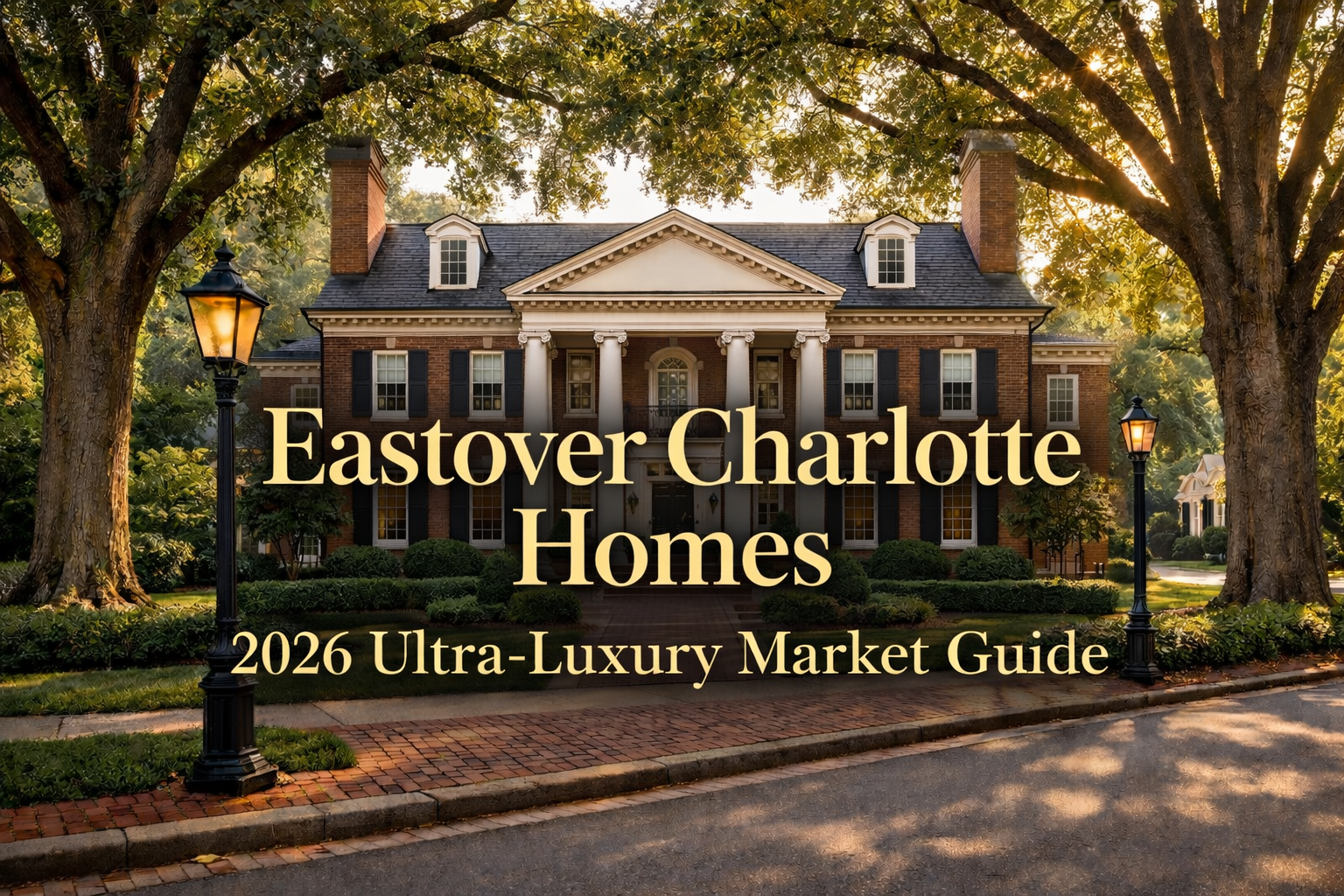
SHORT ANSWER: Eastover is Charlotte's most exclusive historic luxury neighborhood — a 1927 Earle Sumner Draper-planned enclave of Georgian Revival, Tudor Revival, and Colonial Revival estates anchored by the Mint Museum Randolph. The 2026 median home value is approximately $2.86M, with grand estates reaching $4M–$7M+, ~6% YoY appreciation (more than double Charlotte's broader luxury average), and typically fewer than 10 active listings at any time. Located ~2 miles from Uptown with a rare-for-Charlotte Walk Score above 70, Eastover delivers walkable historic prestige that no other neighborhood in the city can replicate. Buyers serious about Charlotte luxury real estate should treat Eastover as a tier-one shortlist candidate — but expect the majority of true opportunities to never reach public MLS.
EXECUTIVE SUMMARY — EASTOVER 2026
- Median home value:~$2.86M (2026), with full price band $750K (entry historic) to $7M+ (grand estates).
- YoY appreciation:~6%, outpacing the broader Charlotte luxury market (~2.5%).
- Inventory: Typically fewer than 10 active listings at any time — among the tightest in Charlotte luxury.
- Architecture: Georgian Revival, Tudor Revival, Colonial Revival; original 1927 Earle Sumner Draper master plan.
- Cultural anchor: Mint Museum Randolph — Charlotte's oldest art museum, on the neighborhood's edge.
- Walkability: Walk Score 70+ — rare among Charlotte luxury neighborhoods (most score 50–60).
- Distance to Uptown:~2 miles, ~10 minutes.
- Lot sizes: Typically 0.5 to 1 acre.
- Off-market reality: The majority of Eastover transactions never appear on public MLS.
There are luxury neighborhoods in Charlotte, and then there is Eastover. While newer South Charlotte communities sell on amenity packages and golf course adjacency, Eastover sells on something far harder to manufacture: nearly a century of architectural pedigree, a museum on its doorstep, and one of the smallest, most tightly held inventory pools in the entire Carolinas luxury market. If you are evaluating where to plant generational capital in Charlotte, Eastover is the address that quietly sets the ceiling for the rest of the city.
This guide is the most data-driven Eastover buyer resource published in 2026 — built from current market analytics, off-market inventory intelligence, historic preservation context, and the specific street-by-street pricing patterns that determine value here. Whether you are relocating from out of state, upgrading from a different Charlotte neighborhood, or evaluating Eastover as a long-term investment hold, the pages below give you the framework to act with conviction.
Layer 1 — Inline: Want a confidential look at Eastover's current off-market opportunities? Request the Luxury Insider Briefing and I'll send you the active and shadow inventory list within 24 hours.
What Eastover Is — and Why Charlotte's Old Money Lives Here
The 1927 Earle Sumner Draper Master Plan
Eastover is a ~270-acre historic luxury neighborhood in central Charlotte, planned and developed beginning in 1927 by Earle Sumner Draper — the same nationally renowned planner responsible for Myers Park. Where Myers Park was Charlotte's first master-planned suburb, Eastover was Draper's encore: smaller, more intimate, more tightly curated, and explicitly designed to attract Charlotte's most prominent families. Nearly a century later, the neighborhood retains the original street pattern, mature canopy, and residential scale that Draper intended — making it one of the most architecturally and historically significant residential districts in the Southeast.
Draper's design philosophy emphasized organic curving streets that followed natural topography, generous lot sizes (most properties sit on 0.5 to 1 acre), and an architectural code that produced a coherent collection of revival-style homes — Georgian Revival, Tudor Revival, and Colonial Revival predominating. The result is a neighborhood that reads as a singular composition: drive any of Eastover's main streets and you experience an unbroken sequence of estate-scale homes set behind mature oaks, magnolias, and boxwood, with virtually no architectural discord. This is the kind of historic continuity that takes generations of careful stewardship to maintain — and that Eastover homeowners have actively defended through informal neighborhood norms even in the absence of a formal HOA.
The neighborhood's residents have long included Charlotte's leading bankers, executives, attorneys, surgeons, philanthropists, and old-line families. Whereas other top Charlotte luxury neighborhoods have grown by adding inventory or annexing land, Eastover has grown almost exclusively through interior renovation and the rare teardown — preserving its scale and scarcity by design.
Architectural Identity: Georgian, Tudor, and Colonial Revival
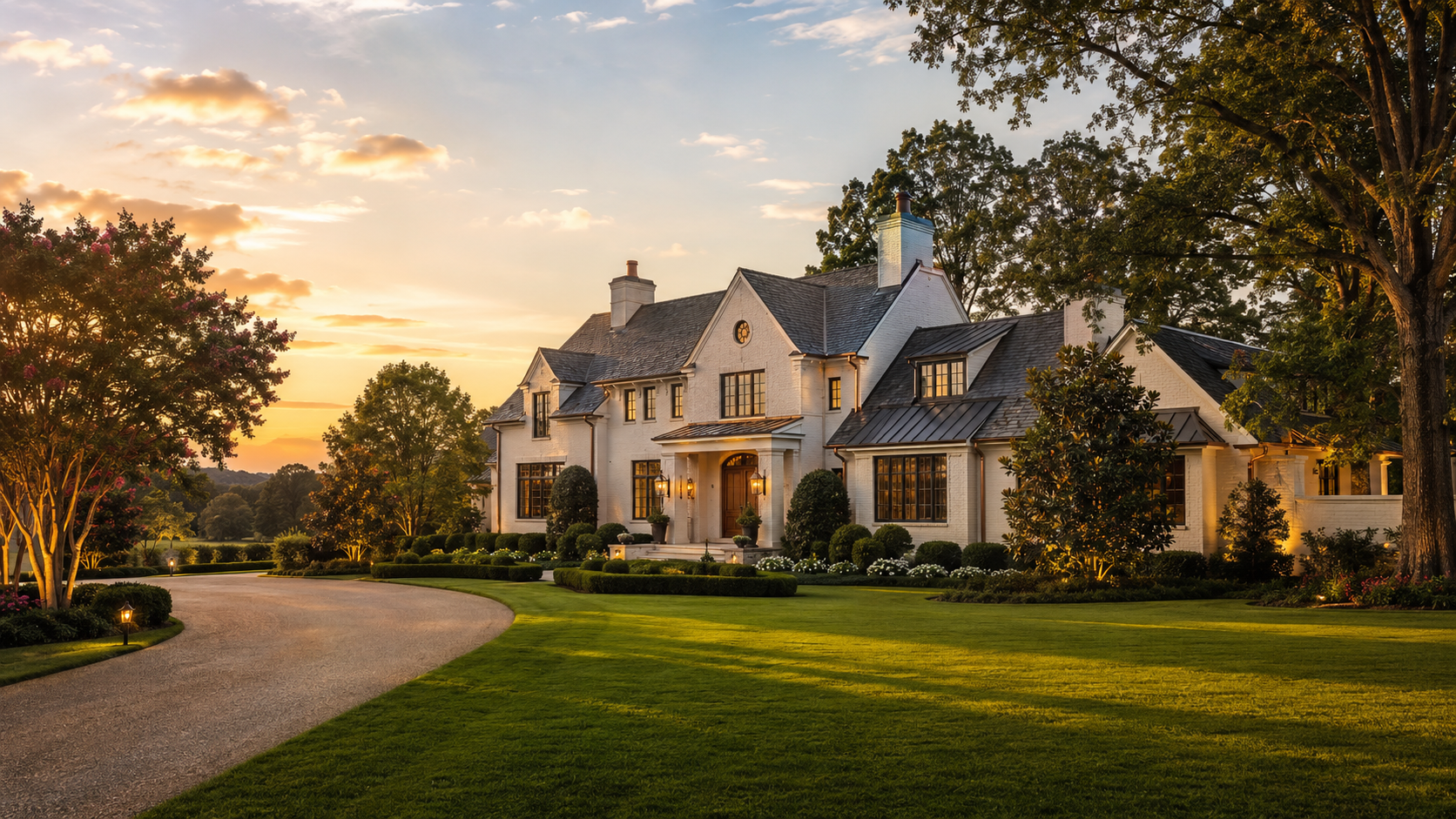
Eastover's housing stock is dominated by three revival styles — Georgian Revival (symmetrical brick facades, formal entries, classical detailing), Tudor Revival (steeply pitched roofs, half-timbering, stone and brick combinations), and Colonial Revival (white trim, columned porches, formal massing). A scattering of French Eclectic, Mediterranean, and modern infill also exists, but the revival trio defines the neighborhood's visual character and supports its premium pricing.
Many of the original 1927–1940s Eastover homes have been meticulously preserved, while others have undergone full down-to-the-studs renovations that retain the historic exterior envelope and update interiors to current luxury standards — chef's kitchens, primary suites with spa baths, climate-controlled wine rooms, smart home integration, and resort-grade outdoor living. The renovation trend matters for buyers: a fully renovated 5,500 sq ft Georgian on Cherokee Road in 2026 is a meaningfully different product than the same address would have been 15 years ago, and the pricing reflects it.
For more on how Eastover compares within the broader luxury landscape, see our companion guides on Quail Hollow and Ballantyne — both meaningfully different in character but frequently appearing on the same buyer shortlists.
Eastover Pricing 2026: Street-by-Street Breakdown
The Streets That Set Eastover's Pricing Tiers
Eastover's pricing is not uniform — it is determined almost entirely by street. Cherokee Road, Hempstead Place, Sherwood Avenue, Museum Drive, and the Providence Road cluster command the neighborhood's top tier, while the perimeter streets and smaller-scale properties on the western edge sit at the entry tier. A 5,000 sq ft Georgian on Cherokee Road and a 5,000 sq ft home three blocks away can differ by $1.5M or more on identical square footage — that is the street premium effect, and it is the single most important pricing dynamic to understand before entering this market.
| Street / Cluster | Tier | Typical Price Range | Character |
|---|---|---|---|
| Cherokee Road | Top | $3.5M – $7M+ | Eastover's most prestigious address; grand Georgian and Tudor estates; mature canopy |
| Hempstead Place | Top | $3M – $6M | Quiet, intimate enclave with some of Eastover's largest lots |
| Sherwood Avenue | Top | $2.5M – $5.5M | Architectural showcase; broad mix of grand revival styles |
| Museum Drive | Top | $2.5M – $5M | Direct Mint Museum proximity; museum-anchored prestige |
| Providence Road cluster | Mid–Top | $2M – $4.5M | Convenient access to Uptown; broader frontage homes |
| Colville Road | Mid | $1.5M – $3M | Renovated mid-century and revival mix; strong family street |
| Eastover Road | Mid | $1.5M – $3.5M | Eponymous central corridor; broad architectural variety |
| Perimeter / smaller-scale streets | Entry | $750K – $1.5M | Smaller historic homes; entry point to the Eastover address |
The street effect is amplified by the fact that public market data sources like Redfin and Zillow do not capture the Eastover off-market segment — meaning the comparables that show up in algorithmic valuations consistently undershoot the true clearing prices on Cherokee Road and Hempstead Place. Buyers relying solely on online estimates will systematically misprice the upper tier and lose deals to buyers with broker-driven intelligence.
Price Per Square Foot and the Investment Case
Eastover's average price per square foot in 2026 sits at $500 to $650+, with top-tier renovated estates on Cherokee Road and Hempstead Place reaching $700+ psf. This price-per-foot is meaningfully above Myers Park ($425–$525 psf) and Foxcroft ($475–$575 psf), reflecting Eastover's combination of scarcity, walkability, and museum-anchored prestige.
The investment case is strengthened by Eastover's appreciation profile: ~6% YoY in 2026, more than double the broader Charlotte luxury market average of ~2.5%. That gap is not new — Eastover has consistently outperformed the broader luxury comp set over rolling 5- and 10-year windows because the supply side is structurally constrained. With typically fewer than 10 active listings at any time, days on market between 60 and 123 days (longer than mass-market because of the buyer-qualification curve), and zero meaningful new construction, Eastover behaves more like a fine-art market than a residential housing market. The math of scarcity drives the math of returns.
The Scarcity Math: Eastover contains roughly 400 to 500 homes within its historic boundaries. With typically fewer than 10 active listings at any time, that means under 2.5% of the neighborhood is on the public market in any given week. Compare that to a typical Charlotte luxury submarket where 5% to 8% of inventory is active, and you see why Eastover commands its premium — and why patient buyers with off-market access systematically outperform those who wait for public listings. For serious buyers, the right question is not "what's listed in Eastover?" — it's "who knows what's about to move?"
CONTENT UPGRADE — EASTOVER SHADOW INVENTORY REPORT
Want the names, streets, and asking-price expectations for the Eastover homes most likely to transact in the next 90 days that have not been publicly listed? I maintain a private shadow-inventory tracker built from broker relationships, owner conversations, and renovation permit data. It is the single most useful document any serious Eastover buyer can hold, and I share it confidentially with qualified buyers only.
The Mint Museum Randolph: Eastover's Cultural Anchor and Pricing Lever
How a Museum Underwrites a Neighborhood's Premium
The Mint Museum Randolph at 2730 Randolph Road is Charlotte's oldest art museum and one of the most consequential cultural institutions in the Carolinas. Located on the eastern edge of Eastover, it functions as a permanent prestige and walkability anchor that no other Charlotte luxury neighborhood can replicate. The museum's presence is one of the structural reasons Eastover commands its premium — cultural institutions of this caliber within a residential luxury district are extraordinarily rare in the Sun Belt, and they do not move.
The Mint Museum Randolph traces its origins to the original 1836 U.S. Branch Mint building, which was relocated to its current site in 1936 and opened as North Carolina's first art museum. Today the museum holds one of the most significant decorative arts and ceramics collections in the American South. For Eastover residents, the museum is both a daily-life amenity (private viewings, member events, walking access for children) and a permanent neighborhood character anchor that shows up in property comparable selection, broker pitches, and the buyer narrative around the address itself.
The pricing impact is most concentrated on Museum Drive and the Sherwood Avenue / Hempstead Place cluster within walking distance — but the halo extends to the entire neighborhood. Buyers who relocate from major coastal metros are accustomed to thinking about residential value in terms of cultural and walkable amenities; for that audience, Eastover is the only Charlotte luxury neighborhood that translates intuitively. This is also one of the reasons Eastover's Walk Score of 70+(Mint Museum, restaurants on Providence Road, proximity to the Myers Park Country Club corridor) is such a meaningful differentiator from other Charlotte luxury neighborhoods that score 50–60.
Eastover vs. Myers Park vs. Foxcroft: The 2026 Decision Framework
The Three-Way Comparison Most Eastover Buyers Actually Run
Eastover, Myers Park, and Foxcroft are the three central Charlotte luxury neighborhoods that appear together on virtually every serious buyer's shortlist. Choosing between them is rarely about price alone — each represents a distinct philosophy of luxury living. Eastover is the smallest, most walkable, and most museum-anchored. Myers Park is the largest, most historically recognized, and most diverse across price points. Foxcroft is the most private, most wooded, and most estate-scaled. The right answer depends entirely on what the buyer is optimizing for.
| Factor | Eastover | Myers Park | Foxcroft |
|---|---|---|---|
| 2026 Median Value | ~$2.86M | ~$2.1M | ~$2.4M |
| Price Range | $750K – $7M+ | $650K – $6M+ | $1M – $8M+ |
| Year Established | 1927 | 1911 | 1960s onward |
| Neighborhood Size | ~270 acres / ~400–500 homes | ~1,200 acres / ~3,000+ homes | ~600 acres / ~700 homes |
| Lot Size (typical) | 0.5 – 1 acre | 0.3 – 1 acre | 0.75 – 2+ acres |
| Architectural Identity | Georgian, Tudor, Colonial Revival | Diverse — Tudor, Colonial, contemporary infill | Estate transitional, brick traditional |
| YoY Appreciation | ~6% | ~3% | ~3.5% |
| Walk Score | 70+ | 55–65 | 40–50 |
| Distance to Uptown | ~2 miles | ~2–3 miles | ~5 miles |
| Cultural Anchor | Mint Museum Randolph | Queens University, Freedom Park | None (residential only) |
| Privacy Profile | High (small scale) | Moderate (busier streets) | Highest (wooded, secluded) |
CHOOSE EASTOVER IF
- You value scarcity and the smallest, tightest historic district
- Walkability and a museum-adjacent address matter to you
- You want the highest YoY appreciation profile of the three
- You're relocating from a coastal metro and want intuitive walkability
- You can move when an opportunity surfaces — patience required
CHOOSE MYERS PARK IF
- You want the broadest inventory across the most price points
- Historic recognition and name resonance matter most
- You value Queens University, Freedom Park, and the broader cultural corridor
- You need flexibility on architectural style
- You want a slightly faster transaction timeline
CHOOSE FOXCROFT IF
- Maximum privacy and wooded acreage are non-negotiable
- You prefer estate-transitional over historic revival architecture
- You're comfortable with lower walkability for greater seclusion
- You want a 0.75–2+ acre lot as a baseline
- You don't need walkable cultural amenities
Off-Market Access: Why the MLS Shows You Less Than Half of Eastover
The Structural Reasons Eastover Transacts Privately
The majority of Eastover transactions never appear on the public MLS. Owners are prominent, ownership tenure is long, and the buyer pool is small enough that experienced luxury brokers often know in advance which homes are likely to move. Owners frequently prefer to sell quietly through referral — avoiding the open-house circus, the speculative showings, and the public price-discovery process — and brokers facilitate this through private networks. For buyers, the practical implication is simple: if you only watch Zillow and Redfin, you are seeing well under half of the actual Eastover opportunity set.
This is not unique to Eastover, but Eastover is one of the most acute examples of the off-market dynamic in the Carolinas. The combination of small inventory, high-net-worth ownership, and a culture of discretion produces a market structure where the public-facing data systematically understates true activity. A buyer relying solely on online listings will frequently conclude that "nothing is for sale" in Eastover at a moment when three or four off-market deals are actively being negotiated by a small group of brokers. The information asymmetry is the entire game.
Working with a broker who maintains active relationships across the Eastover ownership base — and who is trusted by both buyers and sellers in the discreet handoff process — is the only reliable path into the off-market segment. This is the single most valuable thing a buyer can secure when targeting Eastover, and it is the core of how L ISTRE Group operates in this neighborhood.
Jumbo Financing for Eastover: What Buyers Need to Know
The Lender Profile That Wins in Eastover
Virtually every Eastover purchase that uses financing requires a jumbo mortgage — the 2026 conforming loan limit for Mecklenburg County is approximately $806,500, which sits well below Eastover's entry-level pricing. Buyers should expect to work with a private bank, a portfolio lender, or a jumbo specialist rather than a conventional mortgage shop. The right lender relationship is often the difference between winning and losing a competitive Eastover offer, particularly in the off-market segment where speed and certainty of close are weighted heavily by sellers.
Eastover sellers — particularly in the $3M+ tier — frequently prefer cash buyers or buyers with documented private banking relationships and very rapid commitment letters. A buyer with a major coastal private bank relationship (e.g., a wealth-management division offering portfolio-based jumbo lending against a securities account) typically presents as cleanly as cash. For buyers without that profile, working with a jumbo-specialist mortgage broker who can deliver a fully underwritten approval (not just a pre-qualification) before the offer is submitted dramatically improves competitive position.
For more on the financing landscape and how to position competitively, see our seller resources for the perspective from the other side of the table — understanding what sellers prioritize is the fastest way to write a winning offer.
Eastover Charlotte NC — Frequently Asked Questions
The 2026 median home value in Eastover, Charlotte NC is approximately $2.86M. Entry-level historic homes start around $750K, mid-range renovated estates trade between $1.5M and $3M, and grand Georgian, Tudor, and Colonial Revival estates reach $4M to $7M+. Average price per square foot is $500 to $650+, and the neighborhood has appreciated approximately 6% year-over-year — outpacing the broader Charlotte luxury average of ~2.5% YoY.
Eastover is served by Charlotte-Mecklenburg Schools and sits within the Myers Park High School attendance zone — one of the strongest public secondary schools in North Carolina, with International Baccalaureate (IB) programming. Eastover Elementary and Alexander Graham Middle School are the typical feeder pattern. Eastover families also frequently utilize Charlotte's private school corridor, with Charlotte Country Day School, Charlotte Latin School, and Providence Day School all within a 10–15 minute drive.
No — Eastover does not have a community-wide mandatory HOA. The neighborhood operates with full owner autonomy, which is part of the appeal for buyers who prefer historic neighborhoods without a formal architectural review board. That said, many properties carry historic preservation considerations given the 1927 Draper-planned origins, and significant exterior alterations on landmark homes should be approached with care. For most owners, the absence of an HOA means lower carrying costs and more flexibility over their property.
The vast majority of Eastover sits on stable, elevated terrain well outside FEMA's 100-year flood zone. A small handful of properties along Briar Creek and the eastern perimeter may carry partial flood designations and should be evaluated individually using FEMA's Flood Map Service Center before purchase. For most Eastover buyers — particularly on Cherokee Road, Hempstead Place, Sherwood Avenue, and the central core streets — flood risk is not a meaningful concern, and homes do not require federal flood insurance.
The Mint Museum Randolph — Charlotte's oldest art museum, located at 2730 Randolph Road on Eastover's edge — functions as a permanent cultural anchor that supports premium pricing for adjacent homes. Properties within walking distance benefit from enhanced visual character, mature landscaping standards, and the implicit prestige of a museum-adjacent address. Cultural anchors of this caliber are rare in residential luxury neighborhoods nationally, and the Mint contributes to Eastover's higher Walk Score (70+) versus most other Charlotte luxury neighborhoods, which typically score 50–60.
Eastover, Myers Park, and Foxcroft are Charlotte's three most-compared central luxury neighborhoods. Eastover wins on tighter inventory, slightly higher median pricing ($2.86M vs $2.1M Myers Park), Mint Museum proximity, and the most intimate scale of the three. Myers Park wins on historic name recognition and broader inventory across more price points. Foxcroft wins on maximum privacy, larger wooded lots, and gated estate character. Buyers who value scarcity, walkability, and a museum-anchored historic district consistently choose Eastover.
The majority of Eastover transactions never appear on the public MLS because of the neighborhood's small size (typically fewer than 10 active listings at any time), the prominence of its residents, and the long-tenured nature of ownership. Owners frequently transact through private referral networks managed by experienced luxury brokers who maintain relationships with both sides of a potential deal. Buyers serious about Eastover should engage a broker with documented off-market access — relying solely on Zillow or Redfin will surface only a fraction of the actual opportunity set.
REQUEST THE LUXURY INSIDER BRIEFING
Get the Eastover shadow inventory list, current active listings, and a confidential one-page neighborhood analysis. Delivered within 24 hours — qualified buyers only.
REQUEST BRIEFINGSCHEDULE A PRIVATE STRATEGY SESSION
Sit down with Mitch Boraski, MBA — 30 minutes, no obligation. Walk through your Eastover targets, financing profile, and the off-market plan that fits your timeline.
SCHEDULE MEETINGWhy buyers choose L ISTRE Group: 4.9 / 5 across 87 client reviews · MBA + CLHMS designation · Off-market access in Eastover, Myers Park, Foxcroft, Quail Hollow · Powered by eXp Realty, the world's largest independent residential brokerage.
Explore Related Resources
BEST LUXURY NEIGHBORHOODS
The complete 2026 ranking of Charlotte's top luxury neighborhoods — where Eastover sits and how the rest of the field compares.
VIEW RANKINGQUAIL HOLLOW GUIDE
The definitive 2026 guide to Quail Hollow — Charlotte's PGA Tour-anchored South Charlotte luxury enclave.
READ GUIDEBALLANTYNE REIMAGINED
The future of luxury living in South Charlotte — Ballantyne's transformation and what it means for buyers.
READ GUIDELAKE NORMAN WATERFRONT
Charlotte's premier lake luxury market — waterfront estates, boat-up living, and the relocation case.
EXPLOREBUY WITH L ISTRE
The buyer process — how we deliver off-market access, jumbo financing strategy, and a winning offer.
START HERESELL YOUR ESTATE
Selling in Eastover, Myers Park, Foxcroft, or Quail Hollow? See how we market discreetly and execute cleanly.
SELL STRATEGYWhat's Next?
If Eastover is on your shortlist, here is the highest-leverage sequence of next steps to give yourself a real chance at the home you actually want:
- Step 1 — Define your tier. Decide whether you are targeting the entry historic tier ($750K–$1.5M), the renovated mid-range ($1.5M–$3M), or the grand estate tier ($4M+). Your tier determines your strategy.
- Step 2 — Lock in financing. Engage a jumbo specialist or private banking relationship before you start touring. A fully underwritten approval letter wins offers in the off-market segment.
- Step 3 — Get on the off-market list. Request the Luxury Insider Briefing so I can route Eastover off-market opportunities to you as they surface.
- Step 4 — Walk the streets. Spend an afternoon driving Cherokee Road, Hempstead Place, Sherwood Avenue, Museum Drive, and the Providence Road cluster. Eastover rewards buyers who develop a feel for the neighborhood before they make decisions.
- Step 5 — Schedule a 30-minute strategy session. Book a no-obligation meeting with Mitch Boraski, MBA to align on targets, timeline, and the off-market plan that fits your situation.
- Step 6 — Cross-shop intelligently. Compare Eastover side-by-side with Quail Hollow and the broader Charlotte luxury market before committing — clarity comes from informed comparison.
REFERENCES & SOURCES
- Mint Museum Randolph — Official Site(Charlotte's oldest art museum; Randolph Road location and history).
- Earle Sumner Draper — Wikipedia(planner of Eastover and Myers Park; biography and project list).
- Walk Score — Walkability Index(methodology and Charlotte neighborhood scoring).
- Redfin — Charlotte NC Housing Market Data(median value and YoY appreciation comparables).
- Charlotte Regional Realtor Association(Mecklenburg County market reports and luxury segment data).
- Preservation North Carolina(historic preservation context for North Carolina neighborhoods).
- FEMA Flood Map Service Center(Briar Creek and Eastover-area flood zone evaluation).
- Charlotte-Mecklenburg Schools(Eastover Elementary, Alexander Graham Middle, Myers Park High School zones).

Author
Boraski, MBA