
Charlotte Luxury Real Estate Investment 2026 | Mitch Boraski, MBA
Last Updated: March 30, 2026
Executive Summary
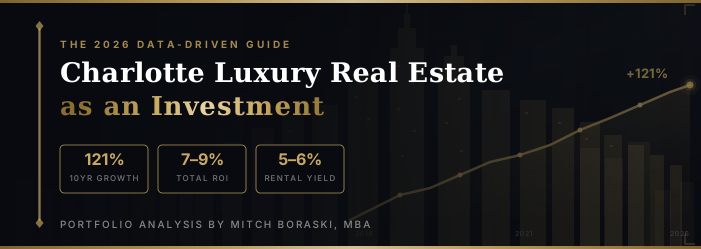
- Charlotte luxury homes have appreciated 121% over the past decade — outperforming most alternative investments on a risk-adjusted basis
- Total ROI of 7–9% combining 4–6% annual appreciation with 3–5% net rental yield, competitive with the S&P 500's 10.4% long-term average when factoring in leverage, tax advantages, and lower volatility
- Charlotte adds 40+ new residents per day with 100,000+ annually migrating to the metro, sustaining rental demand with vacancy at just 4.5%
- NC's flat 3.99% income tax + 1031 exchange eligibility + depreciation deductions create a tax-advantaged structure unavailable in equity markets
- Spring 2026 entry conditions are optimal: sub-6% mortgage rates, 14.4% more inventory, and sellers accepting 95.1% of asking price give investors the best negotiation window since 2021
SHORT ANSWER
Charlotte luxury real estate is one of the strongest alternative investment asset classes available in 2026. A decade of 121% appreciation, rental yields of 5–6%, vacancy rates below 4.5%, and a tax structure that includes depreciation deductions, 1031 exchange deferrals, and NC's 3.99% flat tax deliver total returns of 7–9% annually. With spring 2026 offering sub-6% rates and expanded negotiation leverage, the current entry point is data-defined and favorable for investors.
Whether you are deploying capital from another state, rolling proceeds from a 1031 exchange, or building a local luxury portfolio, the data below lays out exactly where the returns are, what the risks look like, and how Charlotte compares to traditional asset classes. If you are relocating and investing simultaneously, use the Wealth Arbitrage Calculator below to model your specific tax savings.
WEALTH ARBITRAGE CALCULATOR
Discover Your Urban Advantage in Real-Time
Why Charlotte Luxury Real Estate Is an Asset Class in 2026
Charlotte luxury real estate has transitioned from a regional housing market into a legitimate alternative investment asset class, delivering 121% appreciation over the past decade with structural demand fundamentals that most equity markets cannot replicate.
The investment thesis for Charlotte luxury real estate rests on three pillars that institutional investors use to evaluate any asset class: consistent appreciation, income generation, and structural demand drivers.
Consistent appreciation: Charlotte luxury homes have appreciated 121% over the past decade — an annualized rate of approximately 8.3%. The current $800K–$2M segment is appreciating at 4–6% annually, outperforming the broader Charlotte market. This is not speculative growth; it is driven by supply constraints (low inventory in prestige neighborhoods like Myers Park and Eastover) and demand fundamentals (100,000+ net new residents annually).
Income generation: Charlotte luxury rentals deliver gross yields of 5–6% and net yields of 3–5% after management, maintenance, and vacancy. At current maintenance costs and a 4.5% vacancy rate, a $1.5M investment property generating $7,000–$8,500/month in rent produces meaningful cash flow alongside appreciation.
Structural demand: Charlotte adds 40+ new residents per day. The metro's economy is anchored by Bank of America, Wells Fargo, Honeywell, and 19 Fortune 500 companies — creating a deep and diversified tenant pool that does not depend on any single industry. This population momentum has been sustained for over a decade and shows no signs of slowing.
Charlotte Luxury Real Estate vs. the S&P 500: A 10-Year Comparison
Over the past 10 years, the S&P 500 returned approximately 15.6% annualized with dividends reinvested, while Charlotte luxury real estate delivered approximately 8.3% appreciation plus 3–5% rental yield — but with significantly lower volatility, leverage advantages, and tax benefits that close the gap substantially.
| Metric | S&P 500 (10yr) | Charlotte Luxury RE | 10-Year Treasury |
|---|---|---|---|
| Annualized Return | ~15.6% (w/ dividends) | ~8.3% appreciation | ~4.4% yield |
| Income Component | ~1.3% dividend yield | 3–5% net rental yield | 4.4% coupon |
| Total Return (unleveraged) | ~15.6% | ~11–13% | ~4.4% |
| Leverage Available | 50% margin (risky) | 75–80% LTV (standard) | None typical |
| Leveraged Return on Equity | N/A for most | 18–25%+ (w/ 25% down) | N/A |
| Tax Advantages | Capital gains only | Depreciation + 1031 + mortgage interest | State tax exempt (some) |
| Volatility | ~15–20% annual std dev | ~3–5% annual std dev | Low (if held to maturity) |
| Liquidity | Instant (market hours) | 38–78 days | High (secondary market) |
The headline S&P 500 number is higher, but the comparison shifts dramatically when you factor in leverage and taxes. A Charlotte luxury investor putting 25% down on a $2M property invests $500K of equity. If the property appreciates 5% ($100K) and generates $60K in net rental income, the return on equity is 32% — before accounting for depreciation deductions that shelter a portion of that rental income from taxes. No stock portfolio delivers that combination of leveraged return, income, and tax efficiency at the same volatility profile.
The honest trade-off is liquidity. Stocks sell in seconds; Charlotte luxury homes take 38–78 days to sell depending on neighborhood and price band. For investors who can tolerate that time horizon, the risk-adjusted return profile of Charlotte luxury real estate is highly competitive.
Investment ROI by Charlotte Luxury Neighborhood: 2026 Data
SouthPark leads Charlotte luxury appreciation at 5.1% year-over-year, while Lake Norman waterfront offers the best combination of rental yield and negotiation leverage, and Myers Park delivers the strongest 10-year track record for long-term estate appreciation.
| Neighborhood | Median Price | YoY Appreciation | Est. Gross Rental Yield | Best For |
|---|---|---|---|---|
| Myers Park | $2.50M | 4.2% | 3.5–4.5% | Long-term estate appreciation |
| Eastover | $2.86M | 3.1% | 3.0–4.0% | Ultra-luxury portfolio anchor |
| SouthPark | $1.80M | 5.1% | 4.5–5.5% | Appreciation + rental income |
| Foxcroft | $2.20M | 3.8% | 3.5–4.5% | Privacy-oriented estates |
| Lake Norman Waterfront | $1.50M+ | 4.7% | 5.0–6.0% | Highest yield + lifestyle value |
| Uptown/South End Condos | $800K–$1.5M | 3.5–5.0% | 5.5–6.5% | Cash flow + exec rental demand |
The neighborhood-by-neighborhood data reveals a spectrum of investment strategies within Charlotte luxury. For investors prioritizing cash flow, Lake Norman waterfront and Uptown/South End luxury condos deliver the strongest yields — both above 5% gross — driven by executive rental demand from corporate relocations and the lock-and-leave convenience that appeals to traveling professionals.
For investors focused on appreciation, SouthPark at 5.1% YoY growth leads the field, fueled by walkability, new development, and the fastest-moving inventory (38 days on market). The trade-off is that SouthPark's pace leaves less room for negotiation — investors must be prepared to move quickly.
For a balanced portfolio, consider combining a Myers Park estate(long-term anchor with the strongest 10-year appreciation track record) with a South End luxury condo (high yield, low maintenance, strong executive tenant pool). This two-property strategy diversifies across property type, tenant profile, and neighborhood dynamics.
Who Should Invest in Charlotte Luxury Real Estate (and Who Should Not)
Charlotte luxury real estate is best suited for investors with a 5–10 year hold horizon, capital of $400K+ for a down payment, and a tolerance for illiquidity — while offering outsized returns to out-of-state investors who can combine asset appreciation with NC's 3.99% tax arbitrage.
Ideal for out-of-state capital deployment: Investors in California (13.3% state tax), New York (10.9%), New Jersey (10.75%), and other high-tax states gain a structural tax advantage when investing in North Carolina. If you are also considering relocating to Charlotte, the combined savings from lower state income tax, lower property taxes, and lower luxury home prices can exceed $100K annually. Even without relocating, holding investment property in NC creates favorable depreciation and expense deduction scenarios under the 3.99% flat rate.
Ideal for 1031 exchange investors: If you are selling an appreciated property in another market, a 1031 exchange into Charlotte luxury real estate defers capital gains entirely while deploying into one of the strongest appreciation markets in the Southeast. Charlotte's sub-6% rates and expanded inventory make spring 2026 particularly attractive for exchange investors who face the 180-day identification deadline.
Not ideal for short-term flippers: Charlotte luxury properties take 38–78 days to sell, and the 4–6% annual appreciation rate is designed for wealth building over time, not quick profits. Investors seeking 12-month returns should look at different strategies. The Charlotte luxury market rewards patience — the 121% decade return demonstrates what compounding 5–6% annually looks like over time.
Investment Risks and How to Mitigate Them
The three primary risks for Charlotte luxury investors are interest rate volatility affecting carrying costs, concentration risk in a single market, and the illiquidity premium — but each risk has a specific, data-driven mitigation strategy.
Interest rate risk: Sub-6% rates are not guaranteed to persist. If rates rise to 7%, carrying costs on a $1.5M property increase by approximately $750/month. The mitigation: lock your rate at closing (60-day locks with float-down provisions are standard), consider adjustable-rate options if you plan to refinance within 5–7 years, and stress-test your cash flow model at 7.5% rates before purchasing. If the numbers work at 7.5%, you are protected against any realistic rate scenario.
Market concentration risk: Investing entirely in one city exposes you to local economic shocks. Charlotte mitigates this structurally — the economy is diversified across finance (Bank of America, Wells Fargo, Truist), technology (Microsoft, Honeywell), healthcare (Atrium Health, Novant), and logistics. No single employer dominates. Additionally, the population growth of 100,000+ annually is driven by migration from multiple states and industries, not a single boom-bust cycle. Still, sophisticated investors should consider Charlotte as one allocation within a broader portfolio, not their only holding.
Illiquidity risk: Unlike stocks, you cannot exit a luxury real estate position in a day. Charlotte luxury homes sell in 38–78 days depending on neighborhood and price band. The mitigation: maintain a 6-month cash reserve for carrying costs, price correctly from day one (overpriced luxury homes sit for 120+ days), and work with a luxury-specialized agent who can access both MLS and off-market buyer networks to accelerate the sale when needed.
The Charlotte Luxury Investment Deal Sheet
Get a confidential, one page PDF analysis of the top 3 off market and best value luxury investment listings in Charlotte this week. An exclusive look you won't find on Zillow.
How to Invest in Charlotte Luxury Real Estate from Another State
Remote luxury real estate investment in Charlotte follows a five-step process: define your strategy (cash flow vs. appreciation vs. both), partner with a local luxury advisor, structure the purchase through an LLC or trust for asset protection, secure financing with a luxury-focused lender, and establish property management if renting.
Step 1: Define your investment strategy. Cash flow investors should target Lake Norman waterfront or South End condos (5–6.5% gross yield). Appreciation investors should target SouthPark or Myers Park (4.2–5.1% YoY growth). Balanced investors should consider a two-property portfolio combining both approaches. Your strategy determines everything that follows — neighborhood selection, financing structure, and property management requirements.
Step 2: Partner with a local luxury advisor. Remote investing requires a ground-level partner who can provide neighborhood-level market analysis, virtual property tours, and access to off-market inventory that never appears on Zillow or Redfin. In Charlotte's luxury market, 15–20% of transactions happen before properties reach the MLS. A data-driven luxury advisor can identify value that algorithms miss.
Step 3: Structure for asset protection. North Carolina allows purchase through LLCs and trusts, which provide liability protection and estate planning benefits. Our Trust/LLC buying guide covers the complete legal framework. For out-of-state investors, an NC-registered LLC is the most common structure.
Step 4: Secure financing. Luxury investment properties typically require 25–30% down with jumbo loan rates currently in the sub-6% range. For 1031 exchange investors, timing is critical — the 45-day identification window and 180-day closing deadline require pre-approval before your current property closes.
Step 5: Establish property management. Charlotte has several luxury-focused property management firms that handle tenant screening, rent collection, maintenance, and compliance. Typical management fees run 8–10% of monthly rent for luxury properties. For investors who plan to sell the property after the holding period, a management firm also maintains the property's condition to maximize resale value.
The Tax Advantage Stack: Why Charlotte Luxury RE Beats Equities on an After-Tax Basis
Charlotte luxury real estate investors access four tax advantages unavailable in equity markets: residential rental property depreciation over 27.5 years, 1031 exchange deferrals that eliminate capital gains on sale, mortgage interest deductions, and North Carolina's flat 3.99% state income tax rate — the lowest among major Southeast metros.
Depreciation: IRS rules allow residential rental property owners to depreciate the building value (not land) over 27.5 years. On a $2M property with $1.5M allocated to the structure, that is approximately $54,500/year in paper losses that offset rental income — often eliminating your tax liability on rental cash flow entirely. This deduction does not exist for stock dividends or bond interest.
1031 Exchange: When you sell a Charlotte luxury investment property, you can defer 100% of the capital gains by exchanging into another like-kind property. Over a 20-year investment career, this allows you to compound returns without ever paying capital gains tax. For full details on IRS timelines and rules, see our 1031 Exchange guide. For capital gains rules on primary residences, see our Capital Gains Tax guide.
Mortgage interest deduction: Interest on investment property loans is fully deductible against rental income. At sub-6% rates on a $1.5M loan, that is approximately $90,000 in year-one interest deductions — a massive offset that stocks and bonds cannot replicate.
NC's 3.99% flat tax: North Carolina's income tax rate is the lowest among major Southeast states (Georgia 5.39%, South Carolina 6.2%, Virginia 5.75%). For out-of-state investors, net rental income from NC properties is taxed at this 3.99% rate — a significant advantage over states with progressive rates that can reach 13.3% in California. For those also considering relocation, the property tax advantage(Mecklenburg County effective rate ~1.0%) compounds the savings further.
Frequently Asked Questions
Is Charlotte luxury real estate a good investment in 2026?
Yes. Charlotte luxury real estate has delivered 121% appreciation over the past decade, with the $800K–$2M segment currently appreciating at 4–6% annually. Combined with rental yields of 5–6%, total ROI ranges from 7–9% depending on neighborhood and property type. Charlotte also offers structural advantages including population growth of 40+ new residents per day, a diversified economy anchored by finance and tech, and North Carolina's flat 3.99% income tax rate.
How does Charlotte luxury real estate compare to the S&P 500 as an investment?
The S&P 500 has returned approximately 10.4% annualized over the past 100 years with dividends reinvested. Charlotte luxury real estate delivers 7–9% total ROI (4–6% appreciation plus 3–5% net rental yield) with significantly lower volatility. Real estate also offers tax advantages unavailable to stock investors: depreciation deductions, 1031 exchange deferrals, mortgage interest deductions, and North Carolina's favorable 3.99% income tax. The key trade-off is liquidity — stocks sell in seconds while luxury homes take 38–78 days.
What are the best Charlotte neighborhoods for luxury real estate investment?
For appreciation-focused investors, SouthPark leads with 5.1% year-over-year growth at $1.8M median. For rental income, the Uptown/South End luxury condo market offers the strongest yields. For long-term estate value, Myers Park ($2.5M median, 4.2% YoY) has the strongest 10-year track record. Lake Norman waterfront ($1.5M+, 4.7% YoY) offers the best lifestyle-to-value ratio with longer days on market creating negotiation leverage for investors.
Can I invest in Charlotte luxury real estate remotely from another state?
Yes. Remote investment in Charlotte luxury real estate is common and well-supported. The process involves partnering with a local luxury-specialized advisor who can provide virtual tours, off-market access, and neighborhood data analysis. For asset protection, North Carolina allows purchase through LLCs and trusts. For tax optimization, 1031 exchanges from properties in other states into Charlotte luxury real estate defer capital gains entirely. Many out-of-state investors use property management firms for hands-off rental operation.
Explore Related Resources
Investment ROI by Neighborhood
Data-driven analysis of which Charlotte neighborhoods deliver the best investment returns by price band.
Read The Analysis1031 Exchange Guide
Complete guide to deferring capital gains through like-kind exchanges into Charlotte luxury properties.
Explore NowTrust & LLC Buying Guide
Legal structures for asset protection when purchasing luxury investment properties in North Carolina.
Discover MoreWhat's Next?
- Use the Wealth Arbitrage Calculator at the top of this post to model your tax savings if investing from another state
- Request the Investment Deal Sheet for this week's top off-market and best-value luxury investment listings
- Review the 2026–2027 Market Forecast for projected appreciation by neighborhood and price band
- Book a strategy call with Mitch Boraski, MBA to build a personalized Charlotte luxury investment portfolio plan
"The data-driven approach saved us on our purchase. Mitch saw value where other agents missed it."
- R. Patel, Investment Client
Gain an Unfair Advantage
Get the weekly Luxury Insider briefing. We analyze the entire Charlotte luxury market so you don't have to. Off-market deals, price drops, and market shifts, sent to your inbox.
GET THE BRIEFINGMap Your Investment Strategy
Your capital deserves a data-driven deployment plan. Book a confidential strategy call to build a personalized Charlotte luxury investment portfolio tailored to your financial goals.
BOOK MY STRATEGY CALLReferences
- Canopy Realtor Association. (2026). Charlotte Housing Market Opens 2026 with Steady Demand. canopyrealtors.com
- National Association of Realtors. (2026). 2026 Housing Market Forecast. nar.realtor
- Trade That Swing. (2026). Historical Average Stock Market Returns for S&P 500. tradethatswing.com
- The Luxury Playbook. (2025). Charlotte Real Estate Market Overview & Forecast 2025-2026. theluxuryplaybook.com
- Tax Foundation. (2026). State Individual Income Tax Rates and Brackets for 2026. taxfoundation.org
- Zillow. (2026). Charlotte, NC Housing Market Data. zillow.com
- Henderson Investment Group. (2025). 2026 Charlotte Housing Market Predictions for Real Estate Investors. hendersoninvestmentgroup.com
- Bankrate. (2026). Current Mortgage Rates for March 2026. bankrate.com

Author
Boraski, MBA